
Greenup Projected Versus Actual Release
Kentucky’s public correctional search calls its filter “Projected Release Date.” A projected date is KDOC’s current calculation from sentence entries and available credits. It differs from a parole eligibility date, Board hearing date, mandatory-reentry date, minimum expiration date, maximum expiration date, supervision end date, and the actual timestamp when custody changes.
A past projected date with an active status requires follow-up. It does not establish that the person left. Data can change, and KDOC warns that offender information newer than 120 days may not be finalized. Use the dated Daily Releases sheet or an official movement record to prove a state release.
| Date or event | What it means |
|---|---|
| Projected Release Date | Current calculated endpoint based on sentence data and credits |
| Parole Eligibility Date | First review opportunity under the applicable rule, not a release promise |
| Mandatory reentry | Supervised community release before projected completion for qualifying cases |
| Actual release | The custody movement recorded by the releasing agency |
| Final discharge | The formal completion of sentence or supervision |
Find Greenup County Release Dates
Classify custody before searching. A pretrial Greenup detainee usually has no sentence-based projected date. Bond, dismissal, recognizance, a new order, or another case outcome controls. A person serving a purely local sentence needs the Greenup judgment, jail-credit figure, and jail calculation. A state-sentenced prisoner uses KDOC records even when housed at Greenup County Detention Center.
- Ask whether the person is pretrial, locally sentenced, or serving a Kentucky state sentence.
- For a state case, open KOOL and search by DOC/PID number or name.
- Match identity through number, conviction county, offenses, location, and public demographic fields.
- Inspect the precise date labels on the detail record instead of calling every date “projected release.”
- For a local case, obtain the judgment, sentence, jail-credit entry, and any later Greenup court order.
- Check the KDOC Daily Releases archive or the jail movement entry for actual departure.
- Request the sentence-calculation record when the public fields do not explain the result.
KOOL’s advanced search includes Projected Release Date From and To. The portal also supports name, alias, DOC/PID number, status, location, supervision county, offense, conviction, and escape or abscond filters. Its result grid shows name, photo availability, current location, identifiers, and offense counts.
Greenup KOOL Sentence Labels
The public search filter and the offender detail can use different labels. A state inmate record may show Expected Time To Serve, Minimum Expiration of Sentence Date, also described as Good Time Release Date, Parole Eligibility Date, and Maximum Expiration of Sentence Date. A community record may instead show supervision type, status, begin date, end date, location, and county.
| KOOL field | Reading rule |
|---|---|
| Current Location | A prison or jail means confinement; a district points to supervision administration |
| Expected Time To Serve | A calculated sentence field, not the physical release record |
| Minimum Expiration | A credit-sensitive minimum sentence endpoint |
| Parole Eligibility | A review threshold governed by offense and sentence rules |
| Maximum Expiration | The maximum sentence endpoint shown by the record |
| Supervision End | The listed community-supervision endpoint, subject to later action |
Preserve the source label when recording a date. Rewording parole eligibility as “release date” can create a false expectation. Likewise, a district location means the person may be out of confinement but not finally discharged.
Greenup State Sentence Credits
KRS Chapter 197, including KRS 197.045, supplies the central Kentucky sentence-credit rules. Subject to eligibility and exclusions, the law includes 90 days for each qualifying diploma, degree, or approved vocational or technical program. It also permits up to 90 days for each approved treatment, evidence-based, promising-practice, or life-skills program, plus discretionary good-behavior credit of no more than 10 days per month served and specified meritorious-service credit.
Those figures cannot be turned into one public formula for a named person. Credits may be earned, withheld, forfeited, or restored. Jail credit and consecutive sentences change the base calculation. Offense type, offense date, later court orders, and detainers can alter the custody outcome. Consecutive sentences are aggregated for calculation.
The official 501 KAR 2:060 credit regulation is shown below.
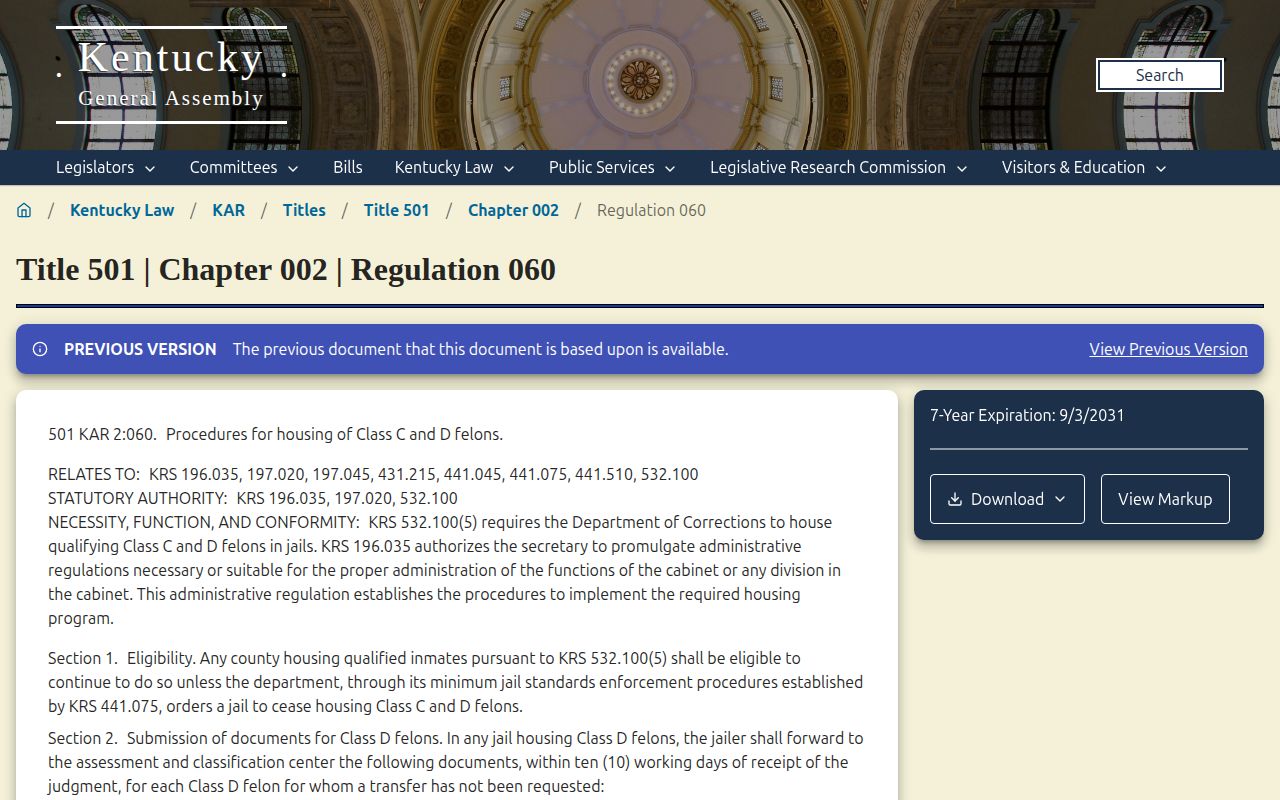
The regulation matters locally because qualified state prisoners can earn applicable statutory, meritorious, educational, and approved-program credits while housed in county jails.
Greenup Jail Holds State Prisoners
Greenup County Detention Center houses both local detainees and DOC-numbered state prisoners. That fact creates two calculation systems under one roof. A local misdemeanor or pretrial case does not acquire a KOOL projected date merely because the person is in the same building as a state prisoner.
For a DOC-numbered prisoner, 501 KAR 2:060 extends qualifying state credit rules to approved jail housing. KOOL can therefore show state calculation fields for a person physically held at Greenup. KDOC Daily Releases can also name Greenup County Detention Center in the “Released From” column.
That state sheet is not the county’s full release log. It captures KDOC events such as discharge, mandatory reentry supervision, or shock probation for the state-sentenced segment. Someone who posts local bond or finishes a local sentence may never appear there. Ask the jail whether the case is local or state before relying on the archive.
Greenup Violent-Offender Date Rules
KRS Chapter 439 includes special rules for statutorily defined violent offenders. The current form of KRS 439.3401 can require a covered term-of-years prisoner to serve at least 85 percent before probation, shock probation, parole, conditional discharge, or another early release, subject to offense date, sentence, findings, exceptions, and restrictions.
Not every Kentucky prisoner serves 85 percent. Many offenses follow other parole-review fractions and credit rules. The parole eligibility regulation implements first-review calculations and contains special entries for covered categories.
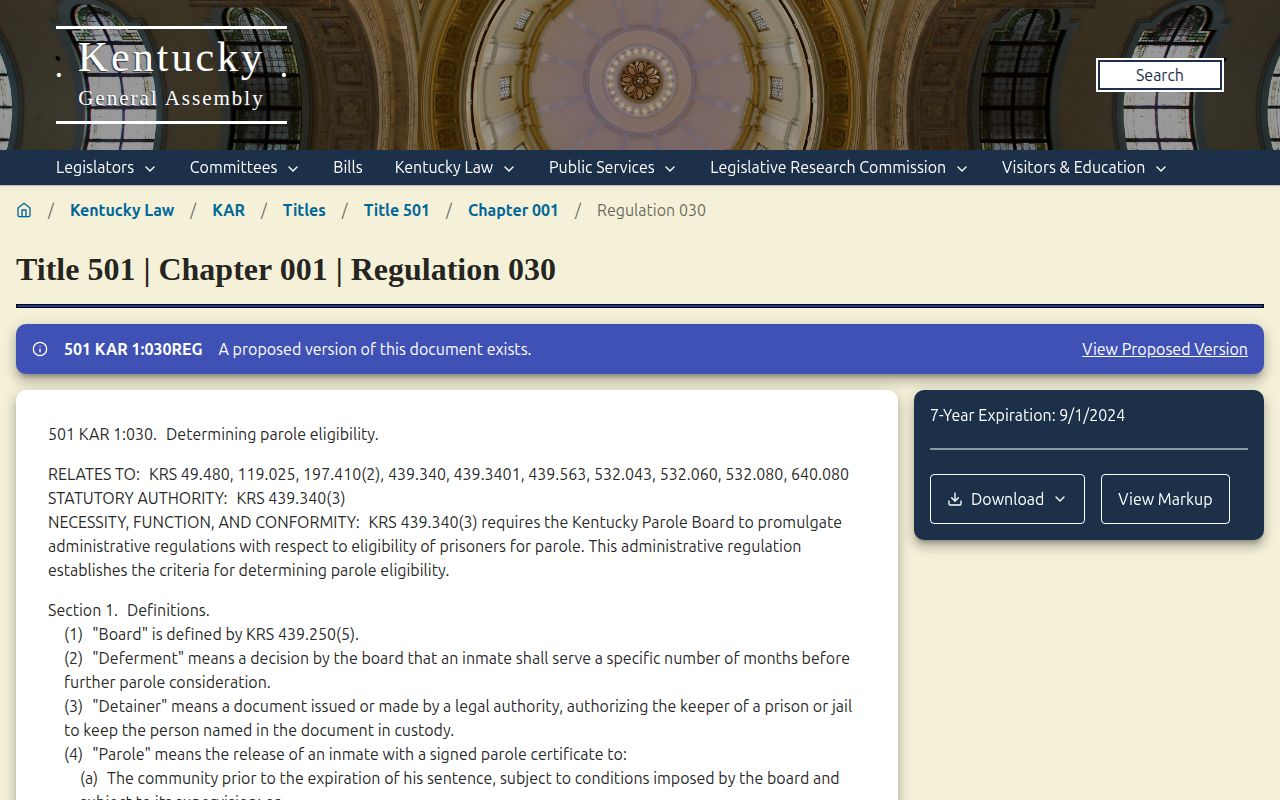
The source shows why offense date and sentence category must be checked before reading a parole threshold. Even an 85-percent parole eligibility point is not the same as projected full-term release.
Changes to Greenup Release Dates
A projected date moves when the legal or factual inputs change. Some changes affect the sentence calculation itself. Others change whether a person can physically enter the community on that date.
| Change | Possible effect |
|---|---|
| Corrected jail credit or sentence entry | Moves the calculated date |
| Earned statutory, educational, meritorious, or program credit | May move the date earlier when available |
| Credit forfeiture or restoration | Can move the date later or earlier |
| New consecutive sentence | Changes the combined calculation |
| Detainer or hold | Can block community release and cause transfer |
| Parole grant, denial, or deferment | Changes the likely custody route, not necessarily full term |
| Mandatory reentry supervision | Creates supervised release before completion for eligible cases |
| Shock probation or court order | Can authorize earlier release |
A detainer is another agency’s request or legal basis to hold or receive a person. Thus, release from Greenup custody may be a transfer, not freedom. Confirm the receiving agency through the jail movement entry.
Confirm Greenup Actual Release
For state prisoners, the KDOC Daily Releases archive is the released-first check. Each dated sheet supplies DOC number, name, legal release type, releasing institution or county jail, and highest felony class. Match the DOC number and exact release label. Then compare KOOL status and location.
For local Greenup custody, call the detention center at 606-473-9660 and request present status plus the existing release or movement entry. Match that record to the Greenup court order. A current roster only shows who is held now; disappearance does not distinguish bond, sentence completion, transfer, another hold, escape, or an entry correction.
When public records do not reconcile, ask KDOC for the movement/release and sentence-calculation records. Written requests can identify the person by full name plus birth date or DOC/PID number. The wider Greenup County release records resource explains the county request and court paths. For future event notice, the Greenup VINELink inmate search can register alerts, but the alert still needs agency confirmation.
Greenup Mandatory Reentry Dates
KRS 439.3406 generally creates six months of mandatory reentry supervision before projected sentence completion for covered prisoners who were not released on discretionary parole, subject to statutory exceptions. The person is outside confinement during that period but has not reached final discharge. KDOC Daily Releases uses specific mandatory-reentry labels and distinguishes in-state from out-of-state supervision.
This distinction is important in Greenup County. The released-from column may name the detention center while the supervision county points elsewhere. Near the Ohio and West Virginia borders, neither the facility nor county of conviction proves where supervision will be administered. Match the KOOL county-of-supervision and current-location fields, then contact the district shown.
A mandatory-reentry date is also not a Parole Board grant. Record the exact Daily Releases type and compare it with the sentence calculation. If the projected completion date later changes, request the calculation record and any order or credit action that explains the change.
Public Record Search
Sponsored Results